
- The single most consequential question in irrevocable trust planning is not which state or which assets — it is who benefits from the trust.
- A self-settled trust — where the grantor remains a beneficiary — provides essentially zero creditor protection in the roughly 30 states without DAPT statutes.
- A non-self-settled irrevocable trust — where the grantor funds the trust exclusively for others — is recognized in every state and rests on centuries of settled law.
- Domestic Asset Protection Trusts (DAPTs) create a narrow statutory exception, but carry a 10-year bankruptcy lookback under 11 U.S.C. § 548(e) and face interstate recognition uncertainty.
- The UltraTrust® system is specifically engineered as a non-self-settled structure — the only design that delivers court-tested protection regardless of jurisdiction.
The distinction between a self-settled trust and a non-self-settled irrevocable trust is the most consequential decision in asset protection planning. This single structural choice — who benefits from the trust — determines whether your trust provides genuine, court-tested creditor protection or collapses entirely the first time a plaintiff’s attorney examines it. Attorneys, financial planners, and clients who miss this distinction risk funding a structure that looks protective on paper but fails completely under litigation pressure. A self-settled trust is one where you fund the trust and remain a beneficiary. A non-self-settled trust — also called a third-party irrevocable trust — is one where you fund the trust exclusively for others: your children, grandchildren, or spouse, with no retained beneficial interest whatsoever. Under the Restatement (Third) of Trusts and the creditor law of virtually every American state, those two structures produce opposite legal outcomes. Understanding why is the foundation of every asset protection decision Estate Street Partners makes on behalf of UltraTrust® clients.
What Is the Legal Difference Between a Self-Settled Trust and a Non-Self-Settled Irrevocable Trust?
A self-settled trust is a trust in which the grantor — the person who funds the trust — retains the right to benefit from the assets transferred. The grantor may receive distributions, enjoy the use of trust property, or access trust resources for personal benefit. The grantor both creates the trust and benefits from it.
A non-self-settled irrevocable trust (third-party trust) is one in which the grantor transfers assets for the exclusive benefit of other named beneficiaries — children, grandchildren, a spouse — and retains absolutely no beneficial interest. The grantor makes a true, completed gift. No retained rights. No side agreements. No ability to reach back.
The legal distinction is simple to state. The consequences are profound.
The foundational principle underlying all creditor protection law — codified in the Restatement (Third) of Trusts § 58(2) and embedded in the trust law of virtually every state — is this: a spendthrift provision cannot protect a beneficiary’s interest from their own creditors if that beneficiary is also the trust’s settlor. The reasoning is as old as equity itself. If you could transfer assets to a trust, name yourself as beneficiary, and then claim those assets are beyond your creditors’ reach, the entire legal framework of debt and accountability would be meaningless. Every person facing liability would do it. The law categorically refuses to permit it.
When the trust genuinely benefits other people — people with their own legal identities, their own creditors, entirely separate from the grantor’s — the spendthrift protection is legitimate. Those beneficiaries did not create the trust. They bear no responsibility for the grantor’s debts. The law protects their interests accordingly.
❓ Q: Can I fund an irrevocable trust and still receive money from it?
A: If you fund an irrevocable trust and retain any right to receive distributions — whether discretionary or mandatory — you have created a self-settled trust. Under the creditor law of approximately 30 states that have not enacted Domestic Asset Protection Trust (DAPT) statutes, that beneficial interest is fully reachable by your creditors. A court can order the trustee to distribute assets to satisfy your judgment, and courts have removed non-compliant trustees and replaced them with court-appointed receivers who will comply. The UltraTrust® system is designed as a non-self-settled structure specifically to avoid this vulnerability. Clients fund UltraTrust® for the benefit of their spouses, children, and descendants — not themselves — which is the only design that produces genuine, legally defensible creditor protection under general trust law applicable in all 50 states.
❓ Q: What makes a non-self-settled irrevocable trust legally enforceable against creditors?
A: Three structural elements make a non-self-settled irrevocable trust enforceable against the grantor’s creditors. First, the grantor must genuinely relinquish all beneficial interest — no retained distribution rights, no ability to reacquire assets, no side agreements with the trustee. Second, the trust must contain a comprehensive spendthrift provision prohibiting both voluntary and involuntary transfer of beneficiaries’ interests. Third, the trustee must be genuinely independent — not the grantor, not the grantor’s spouse, and not someone in a position of financial dependence on the grantor. When all three elements are present and properly documented, the trust assets belong to a separate legal entity whose beneficiaries are not the grantor. A judgment against the grantor personally has no legal path to those assets unless the original transfer can be unwound as a fraudulent conveyance.
What Happens When a Creditor Has a Judgment Against a Grantor With an Irrevocable Trust?
The answer depends entirely on which type of trust was funded.
Non-self-settled trust — clean protection. The assets belong to the trust, a separate legal entity. The beneficiaries are people other than the grantor. The grantor has no legal entitlement to distributions. The spendthrift provision blocks assignment of the beneficiaries’ interests. Unless the original transfer can be voided through fraudulent conveyance litigation under the Uniform Voidable Transactions Act (UVTA), the creditor has no legal path to those assets. The analysis ends there.
Self-settled trust in a non-DAPT state — zero protection. The grantor’s beneficial interest is reachable by the grantor’s creditors as a matter of general trust law. Courts will order the trustee to make distributions to satisfy the judgment. In cases where trustees have refused, courts have removed them and appointed receivers who will comply. The Restatement (Third) of Trusts § 58(2) makes this outcome explicit. In the roughly 30 states without DAPT statutes, self-settled trust protection against the grantor’s own creditors is effectively nonexistent.
❓ Q: What can a creditor actually do to reach assets in my irrevocable trust after getting a judgment?
A: After obtaining a judgment, a creditor’s collection attorneys will conduct debtor examinations, subpoena trust records, and review all trust formation documents searching for one of three vulnerabilities: (1) fraudulent conveyance — the transfer occurred when a creditor claim was foreseeable, making the transfer voidable under UVTA § 4; (2) self-settled structure — the grantor retained beneficial interest, making the trust assets directly reachable under general trust law; or (3) sham trust — the grantor continued to exercise control inconsistent with a genuine transfer, supporting an alter ego argument. A properly structured UltraTrust® eliminates all three vulnerabilities by design: the trust is funded during periods of legal calm with full solvency documentation, structured as non-self-settled with no grantor beneficial interest, and administered by an independent professional trustee whose decisions are documented in writing.
❓ Q: Does a spendthrift provision in my irrevocable trust protect me as the grantor?
A: No. A spendthrift provision protects the beneficiaries of a trust from having their interests seized by their own creditors. It does not protect the grantor. If you are both the grantor and a beneficiary — a self-settled structure — the spendthrift clause provides no protection against your creditors under the Restatement (Third) of Trusts § 58(2) and the trust law of states without DAPT statutes. This is one of the most common misconceptions in asset protection planning. Clients who are told their irrevocable trust has a “strong spendthrift provision” without being told they cannot be a beneficiary of that trust have been given incomplete and potentially dangerous advice. Estate Street Partners addresses this in every UltraTrust® consultation before any trust document is drafted.
What Are Domestic Asset Protection Trusts (DAPTs) and Do They Actually Work?
Beginning with Alaska in 1997, approximately 19 states — including Nevada, Delaware, South Dakota, Wyoming, and Ohio — enacted statutes creating a narrow exception to the self-settled trust rule. A Domestic Asset Protection Trust (DAPT) permits a grantor to be a discretionary beneficiary of an irrevocable trust while still claiming creditor protection, provided strict statutory requirements are met.
A compliant DAPT typically requires: the trust must be irrevocable; a trustee or co-trustee must be a state resident or chartered entity in the DAPT state; trust assets must be held in the state; a spendthrift provision must be included; the grantor cannot retain revocation rights or the ability to direct distributions to themselves; and the trust must be properly registered in the state.
DAPTs also impose a seasoning period — two years in Nevada, four years in Delaware and South Dakota — during which fraudulent conveyance attacks remain available. The promise of DAPTs is appealing: retain access to your assets while claiming creditor protection. The legal reality is considerably more complicated.
The five critical DAPT limitations:
Interstate recognition. A Nevada DAPT is a Nevada statute. A California court with jurisdiction over a California resident may decline to apply Nevada trust law and treat the trust as a standard self-settled trust under California law. The Full Faith and Credit Clause requires recognition of judgments — not necessarily of another state’s substantive trust law. This is genuine, unresolved legal uncertainty.
The 10-year bankruptcy lookback. Under 11 U.S.C. § 548(e), assets transferred to a self-settled trust — including a DAPT — can be unwound in bankruptcy proceedings going back 10 years from the date of transfer. For a non-self-settled trust, only the standard 2-year bankruptcy lookback under § 548(a) applies. This is an 8-year difference in exposure that most DAPT proponents underemphasize.
Retained access undermines protection. If a DAPT trustee makes distributions to the grantor at a level substantially similar to what the grantor would have received by keeping the assets personally, courts skeptical of DAPTs treat the trust as a sham. Distribution history becomes a central fact in any contested DAPT litigation.
Compliance complexity. Maintaining a legally compliant DAPT requires ongoing in-state trustee administration, annual accountings, assets genuinely held in the state, and documentation that satisfies audit scrutiny. Defects in ongoing compliance can retroactively undermine the trust’s protection.
Thin litigation track record. DAPTs have existed for less than 30 years. The body of appellate case law on aggressively contested DAPTs remains small. Experienced trust litigators are skeptical for exactly this reason — there are relatively few instances of a DAPT surviving a well-funded, multi-year creditor attack through final appeal.
❓ Q: Should I use a Nevada DAPT or a non-self-settled irrevocable trust for asset protection?
A: For most clients whose primary concern is protecting accumulated wealth from future creditors — not retaining personal access to trust assets — the non-self-settled irrevocable trust is the superior choice on every measurable legal dimension. It is recognized in all 50 states with no interstate recognition uncertainty. It carries a 2-year bankruptcy lookback, not 10 years. Its legal foundation rests on centuries of equity jurisprudence, not a 25-year-old state statute. And it removes assets from the grantor’s taxable estate entirely — whereas a DAPT may generate estate tax complications because the IRS may include the grantor’s beneficial interest in the taxable estate under IRC § 2036. The UltraTrust® system is designed as a non-self-settled structure because this approach produces the most legally defensible outcome available under U.S. trust law.
❓ Q: What is the 10-year bankruptcy lookback and why does it matter for DAPT planning?
A: Under 11 U.S.C. § 548(e) of the Bankruptcy Code, a bankruptcy trustee can avoid — meaning unwind and reclaim — any transfer made to a self-settled trust within 10 years before a bankruptcy filing, provided the debtor made the transfer with intent to hinder, delay, or defraud creditors. For a DAPT, which is by definition a self-settled trust, this 10-year window applies. For a non-self-settled irrevocable trust, only the standard 2-year lookback under § 548(a) applies. This distinction is enormous in practice. A business owner who funds a DAPT at age 45, encounters financial difficulties at age 52, and files bankruptcy at age 54 may find the entire trust unwound — even though the trust was technically compliant with the state’s DAPT statute when funded. Estate Street Partners specifically structures UltraTrust® as non-self-settled to avoid this 10-year exposure entirely.
Why Does a Non-Self-Settled Irrevocable Trust Remain the Superior Asset Protection Choice?
Four decisive advantages distinguish the non-self-settled structure from every alternative:
Universal legal recognition. Courts in all 50 states recognize the protection of a properly structured non-self-settled irrevocable trust with a spendthrift provision. There is no interstate recognition question, no reliance on a state statute that may be disregarded outside its borders, and no pending legislative risk. The legal foundation is ancient, well-tested, and jurisdiction-neutral.
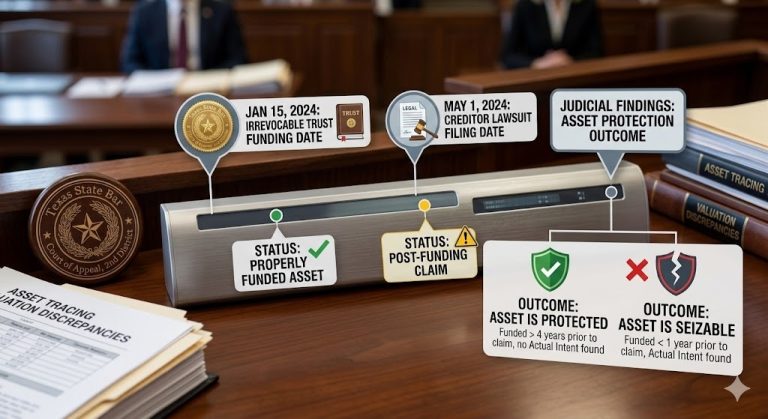
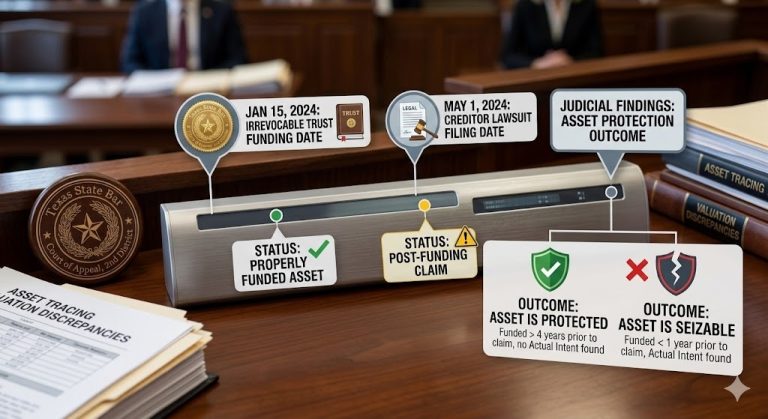
Limited fraudulent transfer exposure. The applicable lookback period is 4 years under the UVTA and 2 years in bankruptcy under § 548(a) — not the 10-year DAPT bankruptcy exposure. For a client who funds a trust during a period of complete legal calm, the protection becomes legally solid within 2 to 4 years.
Complete estate tax removal. A non-self-settled irrevocable trust removes transferred assets from the grantor’s taxable estate entirely under IRC § 2033. A self-settled trust — even a DAPT — may trigger estate tax inclusion under IRC § 2036 if the IRS characterizes the grantor’s beneficial interest as a retained interest.
Multi-generational protection for heirs. One of the most valuable applications of a non-self-settled irrevocable trust is inherited wealth. When a parent structures a child’s inheritance as an irrevocable trust — rather than an outright distribution — those assets are protected from the child’s future creditors, potential divorce proceedings, and financial mismanagement throughout the child’s lifetime. A properly drafted trust with an independent trustee, spendthrift provision, and HEMS distribution standard is one of the most meaningful estate planning gifts a parent can give.
❓ Q: Can an irrevocable trust protect my children’s inheritance from their creditors and divorces?
A: Yes — and this is one of the most underutilized applications of non-self-settled irrevocable trust planning. When you leave assets to a child outright, those assets immediately become the child’s personal property and are fully exposed to the child’s creditors, lawsuits, and divorce proceedings. When you instead structure the inheritance as a properly drafted irrevocable trust with an independent trustee and spendthrift provision, those assets are held in a separate legal entity that the child’s creditors generally cannot reach. In divorce proceedings, trust assets held for the benefit of a child are typically treated as separate property not subject to equitable distribution — provided the trust was properly structured and the child did not commingle trust assets with marital property. Estate Street Partners designs UltraTrust® structures specifically to carry this protection forward through multiple generations, not just for the initial grantor’s lifetime.
❓ Q: What are the required structural elements for a non-self-settled irrevocable trust to actually deliver creditor protection?
A: Six elements are non-negotiable for a non-self-settled irrevocable trust to deliver genuine creditor protection under court scrutiny. First, the grantor must completely relinquish all beneficial interest with no retained distribution rights and no side agreements. Second, the trustee must be genuinely independent — not the grantor, spouse, or anyone financially dependent on the grantor. Third, the trust must contain a comprehensive spendthrift provision covering both voluntary and involuntary transfers of beneficiary interests. Fourth, funding must be fully documented — deeds recorded, accounts retitled, transfers confirmed in writing. Fifth, ongoing administration must be maintained — annual trustee resolutions, accountings, and distribution analyses. Sixth, timing must be clean — the trust must be funded before any legal threat arises, while the grantor is solvent and no creditors are being defrauded. The UltraTrust® system incorporates all six elements as standard institutional practice, refined over 40 years of designing, funding, and defending these structures.
Last Updated: March 2026. This article reflects current federal and state law as of the publication date, including the Restatement (Third) of Trusts, the Uniform Voidable Transactions Act, and 11 U.S.C. § 548(e). This article is for general educational purposes only and does not constitute legal, tax, or financial advice. Estate Street Partners have structured irrevocable trusts for over 40 years with 100% success for clients that fully disclose their fact pattern and follow their instructions. Schedule a free consultation to assess your specific situation and see if you qualify.
Helpful resources: Many readers also review Asset Protection Trust, Revocable vs Irrevocable Trust, and official IRS estate and gift tax guidance when comparing planning options.
Where the next decision becomes clearer
Once What Is the Difference Between a Self-Settled Trust and a Third-Party Irrevocable Trust? is on the table, the next questions usually center on risk, flexibility, and which planning step deserves attention first.
Points readers weigh before moving forward
- Timing matters because planning choices usually become narrower once a problem is already close.
- Control matters because the answer often depends on how much access or authority the owner wants to keep.
- Funding matters because a trust or entity has to be set up and maintained correctly to matter.
Practical reading path
To keep the next step practical rather than abstract, readers often move to Asset Protection Trust, Irrevocable Trust, and How It Works. When the question turns from reading to implementation, many readers move from these guides to a direct planning conversation.