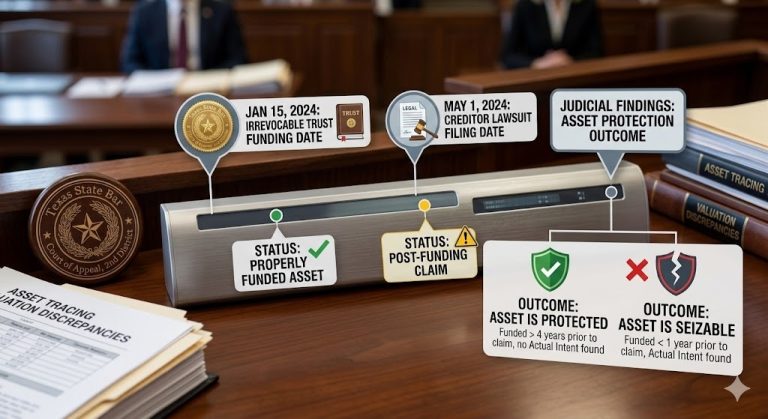
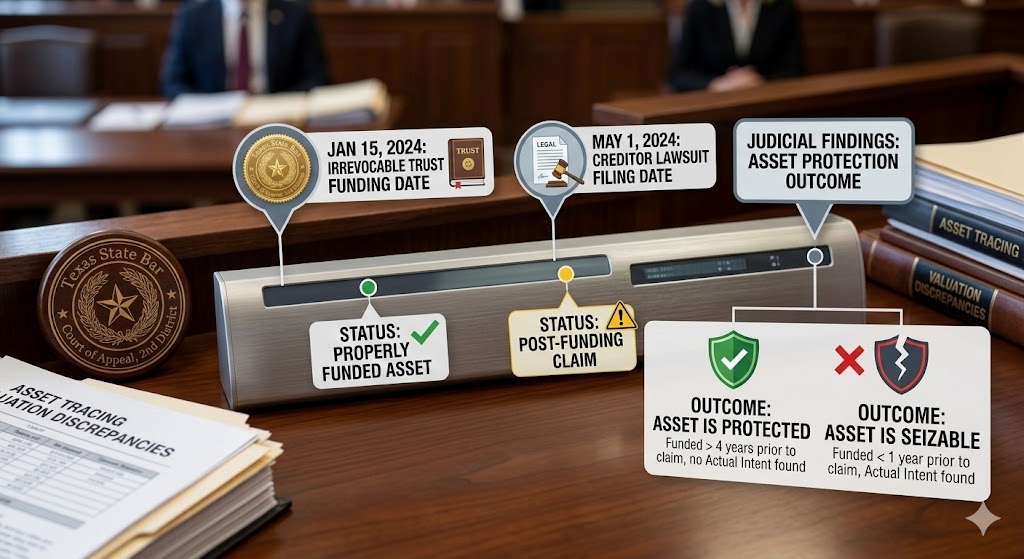
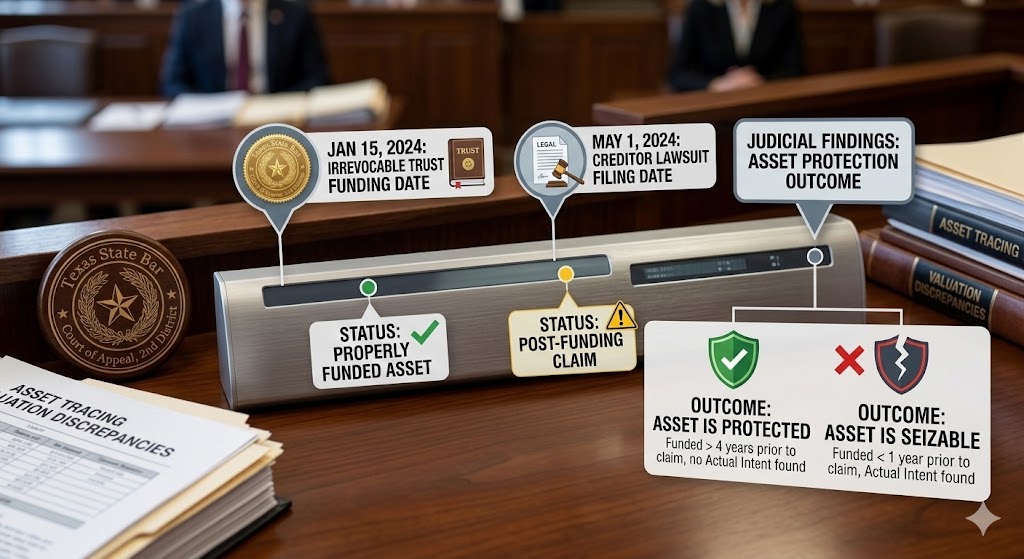
You’re protected! If you are sued after properly transferring assets to an irrevocable trust — and the transfer was not a fraudulent conveyance — your trust assets are protected from that lawsuit. The plaintiff’s attorneys may challenge the trust, but if it was correctly structured, funded before the cause of action arose, and meets your state’s legal requirements, those assets do not belong to you. A personal judgment cannot reach property you do not own. However, the word “after” carries significant legal weight. What matters is not simply whether the lawsuit was filed after the trust was funded — courts examine whether the underlying cause of action arose before or after the transfer, and whether a court could characterize the transfer as a fraudulent conveyance under the Uniform Voidable Transactions Act (UVTA), which has been adopted in 45 states. Getting this analysis right before any legal trouble appears is precisely why Estate Street Partners clients fund UltraTrust® structures during periods of complete legal calm.
- If a lawsuit arises after your trust was properly funded, your trust assets are generally protected — the plaintiff can only collect from assets you personally own at judgment.
- The timeline is everything: courts examine whether the cause of action arose before or after the transfer, not just when the lawsuit was filed.
- A transfer made while a dispute was already foreseeable can be voided as a fraudulent conveyance regardless of how well the trust was drafted.
- Protection solidifies after the applicable fraudulent conveyance statute of limitations runs — typically 2–4 years under the Uniform Voidable Transactions Act (UVTA).
- The UltraTrust® system uses independent professional trustees, contemporaneous solvency documentation, and jurisdiction-specific timing analysis to make every transfer legally defensible from day one.
What Are the Two Scenarios That Determine Whether Your Trust Assets Are Protected?
The single most important analysis in any post-funding lawsuit is the timeline. Two distinct scenarios produce opposite outcomes:
Scenario A — The trust was funded, then the cause of action arose. You fund your irrevocable trust in January. In March of the following year, you are involved in a car accident and the injured party sues you. The cause of action arose after the trust was funded. Assuming the transfer was not a fraudulent conveyance — because there was no foreseeable lawsuit at the time of funding — your trust assets are protected from this new claim. Estate Street Partners structures every UltraTrust® with this clean-slate timeline as the target baseline.
Scenario B — The cause of action predated the trust funding. You fund your trust in January. The plaintiff claims you committed fraud against them in December of the prior year. Even though the lawsuit was filed after the trust was funded, the underlying cause of action predates the transfer. Under UVTA § 4(a)(1), a court may find the transfer was made with actual intent to hinder or defraud a creditor whose claim already existed — and void the transfer entirely.
Identifying which scenario applies is the first and most critical step in evaluating your protection.
❓ Q: Does it matter when the lawsuit was filed, or when the cause of action happened?
A: The date the lawsuit is filed is largely irrelevant to fraudulent conveyance analysis. What courts examine under the Uniform Voidable Transactions Act is when the underlying cause of action arose — meaning when the event giving rise to the claim actually occurred. A lawsuit filed two years after your trust was funded can still unwind your protection if the plaintiff can show the claim originated before the transfer date. Estate Street Partners addresses this risk directly during the UltraTrust® intake process by conducting a contemporaneous liability audit: documenting that no foreseeable claims, disputes, or creditor relationships existed at the time of funding. This documentation becomes part of the trust record and is the primary defense against any retroactive fraudulent conveyance argument.
❓ Q: What if I wasn’t being sued yet but knew a dispute might be coming?
A: Courts apply both an “actual fraud” test and a “constructive fraud” test under the UVTA. Even without proof of intent, a transfer can be voided if it was made while the grantor was insolvent or if the grantor failed to receive reasonably equivalent value. More critically, if emails, demand letters, or documented business disputes existed before the transfer, a court may find the grantor had reason to anticipate a creditor claim — which is enough to trigger constructive fraud analysis. The UltraTrust® system requires clients to disclose all known and reasonably foreseeable disputes before funding. Transfers are only completed when the liability environment is clean and fully documented.
What Will the Plaintiff’s Attorneys Do When They Discover Your Irrevocable Trust?
Sophisticated plaintiff’s attorneys who learn their client is suing someone with irrevocable trust assets will not simply accept those assets as unreachable. They pursue a systematic sequence of legal strategies.
Discovery into trust formation. During discovery, attorneys will subpoena all trust formation documents — the trust agreement, funding records, financial statements at the time of funding, attorney correspondence, and anything showing why and when the trust was created. They are looking for evidence of fraudulent intent or structural defects.
Fraudulent conveyance timeline analysis. They will map every date precisely: when did the cause of action arise, when was the trust funded, was the grantor solvent after the transfer, was adequate consideration received, and did the grantor retain control inconsistent with a genuine transfer.
Alter ego and piercing arguments. Attorneys will look for evidence that the grantor continued using trust assets as personal property — whether the trustee consistently deferred to the grantor’s wishes, whether distributions were made on demand without genuine trustee analysis, or whether the trust and the grantor operated as a single entity.
Contempt proceedings. In cases involving offshore trusts, a court may order the grantor to repatriate assets. If the grantor claims inability to comply, contempt proceedings may follow. This is one reason the UltraTrust® system is structured as a domestic trust with genuine independent trustee authority rather than a nominee offshore arrangement.
❓ Q: Can a plaintiff freeze my trust assets while the lawsuit is ongoing?
A: In some jurisdictions, a plaintiff can seek a preliminary injunction prohibiting asset distributions from the trust during active litigation. Whether this succeeds depends on the strength of the fraudulent conveyance argument, the jurisdiction’s law, and whether the court finds a credible basis for the claim. A well-structured UltraTrust® with independent professional trustee administration and a clean pre-litigation timeline is far harder to freeze than a self-trusteed or recently-funded structure. Estate Street Partners clients maintain continuous trust accounting records precisely so that any injunction hearing is met with a documented record of independent trustee decision-making — not a paper trust that looks like the grantor never actually relinquished control.
❓ Q: What is an “alter ego” argument and how does it threaten my trust?
A: An alter ego argument is a legal theory that the trust is not a genuinely separate legal entity — it is simply the grantor operating under a different name. If a court accepts this argument, the trust’s asset protection disappears entirely and the assets are treated as personally owned. Courts look for specific indicia: the grantor directs all trustee decisions, distributions occur whenever the grantor requests them without independent review, trust funds are commingled with personal accounts, or the trustee is a family member who exercises no independent judgment. The UltraTrust® system is specifically engineered to defeat alter ego claims. Estate Street Partners appoints a professional independent trustee with no familial or financial relationship to the grantor, maintains separate trust accounts, and administers distributions under written trustee analysis — not grantor request.
How Does a Court Conduct the Fraudulent Conveyance Analysis?
Fraudulent conveyance law — codified in the UVTA and its predecessor the Uniform Fraudulent Transfer Act (UFTA) — is the primary legal weapon used against irrevocable trusts. Courts weigh a specific set of factors enumerated in UVTA § 4(b):
Timing relative to the debt. A transfer made years before any legal dispute is far more defensible than one made shortly after a demand letter. In Grupo Mexicano de Desarrollo v. Alliance Bond Fund (527 U.S. 308), the Supreme Court emphasized that equitable remedies against asset transfers require a demonstrated connection between the transfer timing and the creditor’s claim.
Insolvency at time of transfer. Under UVTA § 5, a transfer made while the grantor was insolvent — or that rendered the grantor insolvent — is voidable by an existing creditor regardless of intent. Solvency documentation at the time of funding is therefore not optional; it is foundational.
Retention of control. UVTA § 4(b)(8) specifically lists retention of possession or control as a badge of fraud. A grantor who continues to use transferred property as personal property, or whose “trustee” consistently executes the grantor’s instructions without independent review, has provided plaintiff’s attorneys with direct statutory evidence of fraudulent intent.
Pattern of transfers. Multiple asset transfers occurring in a compressed window around the time a legal dispute emerged constitute a pattern courts treat as evidence of fraudulent intent under UVTA § 4(b)(5).
Concealment. Attempting to hide the trust’s existence from creditors or the court — UVTA § 4(b)(3) — is among the most damaging facts a grantor can create. Discovery of concealment typically results in sanctions, adverse inferences, and may trigger criminal referral.
❓ Q: What specific documentation makes an irrevocable trust transfer defensible against a fraudulent conveyance attack?
A: A legally defensible transfer requires several contemporaneous documents created at the time of funding — not reconstructed afterward. These include a solvency certificate or net worth statement signed at the time of transfer, an attorney opinion letter confirming the grantor had no known creditors or foreseeable claims, independent trustee acceptance documentation showing the trustee conducted independent due diligence before accepting the assets, and a statement of purpose establishing the legitimate estate planning objectives of the transfer. Estate Street Partners prepares all of these documents as standard components of every UltraTrust® engagement. Courts that have reviewed UltraTrust® formation records consistently find the documentation package sufficient to defeat constructive fraud arguments — because the records show exactly what a legitimate, non-fraudulent transfer looks like.
❓ Q: How does insolvency at the time of transfer affect my trust’s protection?
A: Under UVTA § 5, a transfer made by an insolvent grantor — or one that rendered the grantor insolvent — is voidable by existing creditors without any need to prove fraudulent intent. Insolvency is defined as liabilities exceeding the fair value of assets, excluding exempt property. This means even a perfectly drafted trust with an excellent independent trustee can be unwound if the grantor transferred assets they could not afford to transfer given their existing obligations. Estate Street Partners requires clients to complete a full liability disclosure and net worth certification before any UltraTrust® transfer is executed. Transfers are structured to preserve the grantor’s solvency — meaning sufficient unencumbered assets remain outside the trust to satisfy all existing and reasonably anticipated obligations at the time of funding.
What Should You Do Immediately If You Are Sued After Funding an Irrevocable Trust?
Stop making additional transfers. Any asset transfer to any trust, LLC, or other structure after you have been served is almost certainly a fraudulent conveyance. Cease all asset movements immediately.
Coordinate with the trustee on distributions. Distributions made to you during active litigation become your personal property and are immediately reachable by a judgment creditor. Coordinate with the trustee — through counsel — to minimize distributions during the litigation period.
Assemble pre-lawsuit trust administration records. Gather evidence of independent trustee decision-making, annual trust accountings, distribution analyses, and all documentation showing the trust was operating properly before the lawsuit. This is the core of your defense.
Engage an asset protection attorney, not just your litigator. General litigation counsel may lack familiarity with fraudulent conveyance law and trust protection analysis. A specialist who can assess the fraudulent conveyance risk and identify structural vulnerabilities should be engaged immediately. Estate Street Partners frequently works alongside litigation counsel in exactly this capacity.
Do not conceal the trust. Attempting to hide the trust’s existence during discovery is the single most destructive mistake a grantor can make. Courts treat concealment as direct evidence of fraudulent intent, and discovery of it invites sanctions, adverse inferences, and criminal referral.
❓ Q: If I win the lawsuit, does my irrevocable trust remain intact?
A: Yes. A successful defense against a lawsuit has no legal effect on your irrevocable trust. The trust continues operating as designed, the trustee retains full authority, and normal trustee distributions can resume. The trust’s protection is not contingent on whether you win or lose the underlying lawsuit — it is contingent on whether the trust itself was properly structured and funded before the cause of action arose. Estate Street Partners clients who have been sued and successfully defended those actions have experienced no disruption to their UltraTrust® structures. The trust was not the subject of the litigation — it was simply never reachable.
❓ Q: What if the plaintiff wins a judgment — what happens next?
A: If a judgment is entered against you, the collection phase begins and the plaintiff’s attorneys will focus intensively on your trust. They will conduct debtor examinations, subpoena trust records, demand accountings, and potentially petition the court to void the transfer as fraudulent. The trust’s ability to withstand this pressure depends entirely on three things: the strength of its original structure, the quality of its ongoing administration, and the timeline of its funding relative to when the cause of action arose. A UltraTrust® funded years before any foreseeable claim, with complete independent trustee records and contemporaneous solvency documentation, is in the strongest legally defensible position available under U.S. trust law.
How Long After Funding Does Irrevocable Trust Protection Become Legally Solid?
Protection solidifies in layers based on the applicable statute of limitations:
Under the Uniform Voidable Transactions Act (UVTA) § 9, the limitations period for fraudulent conveyance claims is generally four years from the date of transfer, or one year from the date the claim was or reasonably should have been discovered — whichever is later. Some states with self-settled domestic asset protection trust (DAPT) statutes impose longer look-back periods: Nevada uses a two-year period, South Dakota uses two years, while Ohio allows ten years for self-settled trusts. For Medicaid planning, the federal five-year look-back period under 42 U.S.C. § 1396p(c)(1) applies separately.
For most clients using properly funded irrevocable trusts in appropriate jurisdictions, the protection becomes legally rock-solid within two to four years of funding — provided no cause of action existed at the time of transfer, the grantor was solvent, and the trust has been continuously and independently administered.
Three Real-World Outcomes From UltraTrust® Case History:
The Physician (Protected): A surgeon funded an irrevocable trust seven years before a malpractice suit was filed. Plaintiff’s attorneys found the trust during discovery, reviewed the formation documents, and concluded the transfer predated the malpractice incident by years with no foreseeable litigation risk at the time of funding. No fraudulent conveyance claim was pursued. Trust assets were untouched throughout litigation and after judgment.
The Business Owner (Partially Protected): A business owner funded a trust two years before a contract dispute lawsuit was filed. Plaintiff’s attorneys produced emails showing the contract had been in active dispute for six months before the trust was funded. A court found a partial fraudulent conveyance for assets transferred after the dispute became apparent — but upheld full protection for assets transferred before the dispute arose. Proper pre-dispute timing saved the majority of the trust estate.
The Developer (Not Protected): A real estate developer transferred personal assets to a self-drafted internet template trust three weeks after receiving a demand letter. He served as his own trustee. The court voided the transfer entirely as a fraudulent conveyance, found the trust to be a sham due to the self-trustee arrangement, and permitted the contractor to collect in full. This outcome is the precise scenario the UltraTrust® independent trustee structure and pre-funding liability audit are designed to prevent.
❓ Q: Does my irrevocable trust protect assets I acquire after it is funded?
A: Only assets that are formally transferred into the trust are protected. Assets you acquire after funding and hold in your personal name are fully exposed to judgment creditors. This is a critical ongoing maintenance point that Estate Street Partners addresses with every UltraTrust® client: as you acquire new assets — real property, investment accounts, business interests — a plan must exist for how and when each asset is transferred into the trust structure. A trust that was properly funded at inception can be gradually hollowed out simply by allowing post-funding acquisitions to accumulate in personal name without being incorporated into the trust.
❓ Q: How quickly can an irrevocable trust be set up if I’m concerned about future liability?
A: An irrevocable trust should never be established reactively in response to a known or imminent threat — that is the definition of a fraudulent conveyance. The correct time to establish an UltraTrust® is during a period of complete legal calm: no active disputes, no known creditors, no foreseeable litigation. Estate Street Partners can typically complete a fully documented UltraTrust® engagement within 30 to 60 days from initial consultation to funded trust, depending on asset complexity and jurisdictional requirements. The urgency, if any, should be in recognizing that the window for clean, defensible trust funding closes the moment a creditor relationship or dispute becomes foreseeable — not the moment a lawsuit is filed.
Last Updated: March 2026. This article reflects current federal and state law as of the publication date, including the Uniform Voidable Transactions Act as adopted across 47 states. This article is for general educational purposes only and does not constitute legal, tax, or financial advice. Estate Street Partners have structured irrevocable trusts for over 40 years with 100% success for clients that fully disclose their fact pattern and follow their instructions. Schedule a free consultation to assess your specific situation and see if you qualify.
Helpful resources: Common follow-up reading includes Asset Protection Trust, Revocable vs Irrevocable Trust, and official IRS estate and gift tax guidance when weighing practical next steps.
What often changes the answer
After reviewing What Happens to My Assets If I Get Sued After Putting Them in an Irrevocable Trust?, many people want a clearer sense of how the answer changes once real life timing, funding, and control are added to the discussion.
What usually shapes the next step
- Timing matters because asset protection works best before a claim becomes immediate.
- Control matters because keeping too much direct control can weaken the protection people hoped to create.
- Funding matters because creditors usually look at what was transferred, when it moved, and how the structure operates.
Where readers often continue
A practical next reading path is Asset Protection From Lawsuit, Asset Protection Trust, and Irrevocable Trust. When the question turns from reading to implementation, many readers move from these guides to a direct planning conversation.