
Is It Too Late to Protect My Assets if I Know a Lawsuit is Coming?
Moving assets after a lawsuit threat typically constitutes fraudulent transfer — a serious legal offense that can expose you to criminal liability and actually worsen your position. However, legitimate strategies remain available even after a threat emerges: maximizing applicable state exemptions, purchasing life insurance up to unlimited exemption limits, restructuring business entities for genuine business purposes, and converting non-exempt assets into exempt ones. The Uniform Voidable Transactions Act (UVTA), adopted in 47 states, defines the legal line precisely. Prevention through proactive planning — established 5+ years in advance — is the most prudent strategy.
Introduction
One of the most dangerous moments in personal finance is the moment a lawsuit threat appears. Business owners, physicians, contractors, and investors feel a sudden, urgent need to protect what they have built. The instinct is understandable. The consequences of acting on it incorrectly are severe.
The law of fraudulent transfer was designed for exactly this situation. It exists to prevent debtors from hiding assets from legitimate creditors at the last minute. Courts apply it aggressively. Transfers made after a lawsuit is filed — or even after a lawsuit becomes reasonably foreseeable — are presumptively suspect. If a creditor can demonstrate that a transfer was made with intent to hinder, delay, or defraud them, the court can unwind the transfer entirely, as if it never happened. Worse, if the transfer was part of a deliberate scheme, criminal fraud charges become possible.
Yet the situation is not hopeless for someone facing an imminent threat who has not yet planned. Several legitimate strategies remain available, and understanding which ones they are — and equally importantly, which ones are not — is critical. The difference between legal restructuring and fraudulent transfer is sometimes a matter of days or even hours. This guide explains the legal framework, the specific strategies that remain available, and how to think about the situation clearly when time is short.
Estate Street Partners has guided clients through imminent liability situations for 40+ years. The consistent lesson: acting strategically within the law still makes a meaningful difference. Acting impulsively outside it makes everything worse.
What Counts as a Known Lawsuit Threat Under the Law
The legal trigger for fraudulent transfer analysis is not the filing of a lawsuit. It is the reasonable foreseeability of a creditor claim. Courts do not wait for a formal complaint to be filed before scrutinizing asset transfers. The standard is whether a reasonable person in your position would have anticipated the liability.
Specific events that courts treat as establishing foreseeability include: a formal demand letter from opposing counsel; a patient complaint filed with a medical licensing board; an EEOC charge filed by a current or former employee; a documented verbal threat of litigation; a known business dispute that has escalated; or even industry-wide litigation patterns that a sophisticated actor should have anticipated.
The Uniform Voidable Transactions Act (UVTA), in force in 47 states, uses the concept of “actual intent to hinder, delay, or defraud any creditor.” Notably, the statute does not require knowledge of a specific creditor or claim — it covers transfers made with general intent to place assets beyond the reach of potential future creditors. This makes the standard broader than many people realize.
The practical implication: if you are a physician who has just received a patient complaint letter, or a business owner who has just received a demand from a contract counterparty, the window for traditional asset protection planning may have already closed. What remains is a narrower set of legitimate options — not the full range of protective strategies available to someone who planned years in advance.
The 11 Badges of Fraud: How Courts Identify Fraudulent Transfers
Because actual fraudulent intent is rarely confessed, courts use circumstantial evidence. The UVTA Section 4(b) codifies 11 “badges of fraud” — factors courts weigh when evaluating whether a transfer was fraudulent:
1. Transfer to an insider. Family members, business partners, entities you control — transfers to these parties draw automatic scrutiny because they allow you to retain effective access to the assets while nominally removing them from your name.
2. Retention of possession or control. If you transfer your home to a trust but continue to live there rent-free, manage it, and treat it as your own, courts will look through the transfer.
3. Concealment. Any effort to hide the transfer — not recording a deed, using nominee arrangements, or failing to disclose assets in discovery — is a powerful indicator of fraudulent intent.
4. Transfer before or after a lawsuit or threat. Timing is the most commonly cited badge of fraud. The closer the transfer is to the threat, the more suspicious it appears.
5. Transfer of substantially all assets. Removing most or all of your assets in one transaction suggests the purpose was to evade creditors rather than serve a legitimate purpose.
6. Absconding. If you leave the jurisdiction after making transfers, courts treat this as consciousness of guilt.
7. Removal or concealment of assets. Moving physical assets, emptying bank accounts, or closing accounts following a threat are all red flags.
8. Value was not reasonably equivalent. Selling a $500,000 property for $1 to a family member is the textbook example of a fraudulent transfer.
9. Debtor was insolvent or became insolvent shortly after. If the transfer left you unable to pay your debts, the transfer is constructively fraudulent even without proof of intent.
10. Transfer shortly before a large debt was incurred. Taking out a loan and immediately transferring the proceeds to protected accounts raises serious concerns.
11. Transfer to a lienor leaving insufficient assets. Transferring business assets while retaining only encumbered property suggests an intent to frustrate creditors.
No single badge is conclusive. Courts weigh the totality. But three or more badges present in the same transaction creates a compelling fraudulent transfer case for the creditor.
What Remains Legally Available After a Threat Emerges
Despite the significant restrictions imposed by fraudulent transfer law, several legitimate strategies remain available after a lawsuit threat has materialized. These are not workarounds — they are well-established legal rights that courts consistently uphold.
Maximizing state exemptions. Every state provides a set of exempt assets that creditors cannot reach regardless of when they were acquired. The key is that using these exemptions must not itself constitute a fraudulent transfer. Converting non-exempt assets into exempt ones — for example, paying down a mortgage on a homestead-exempt property, purchasing life insurance with unlimited cash value exemption (available in Florida, Texas, and several other states), or contributing to an exempt retirement account — is generally permissible even when a claim is imminent, provided it does not render you insolvent.
Purchasing life insurance. Many states provide unlimited or very high exemptions for life insurance cash value and death benefits. Florida, Texas, and a handful of other states exempt life insurance proceeds entirely from creditor claims. Converting cash into a life insurance policy that is statutorily exempt is a recognized strategy that courts have generally upheld even when done relatively close to a known threat — provided it is done in compliance with state law and contribution limits.
Legitimate business restructuring. If you have genuine business reasons to reorganize — combining or separating business entities for operational purposes, bringing in a business partner with genuine capital contributions, or restructuring compensation arrangements — these changes may survive fraudulent transfer scrutiny even if they incidentally reduce your exposed assets. The key is authentic business purpose, contemporaneous documentation, and fair value exchange.
Insurance. Increasing liability insurance coverage is always available and is never a fraudulent transfer. While insurance cannot protect assets from a judgment that exceeds policy limits, it can cap the practical exposure in most litigation scenarios. Umbrella policies, professional liability policies, and directors and officers coverage can all be increased even after a threat materializes.
Negotiation and settlement. Sometimes the most effective strategy when facing an imminent threat is direct engagement with the potential plaintiff. An early, pre-litigation settlement often costs significantly less than a full defense — and avoids the public record and reputational damage of a trial. This is not an asset protection strategy per se, but it addresses the underlying risk.
What You Absolutely Cannot Do
The line between legitimate restructuring and fraudulent transfer must be clearly understood. The following strategies, frequently attempted by desperate defendants, are either illegal, highly likely to be unwound, or both.
Transferring assets to family members for no value. This is the most common and most obvious fraudulent transfer. Courts see through it immediately. The transfer will be unwound, the assets will be returned to your estate, and you may face additional sanctions.
Creating an irrevocable trust after a claim is known. A properly structured irrevocable trust established years in advance is the gold standard of asset protection. The same trust created after a lawsuit is filed or threatened is a textbook fraudulent transfer. Courts can void the transfer and potentially sanction your attorney as well.
Moving money offshore. Hiding assets in overseas accounts without proper legal structure is not asset protection — it is fraud. Federal law (including the Bank Secrecy Act, FBAR filing requirements, and FATCA) requires disclosure of foreign accounts. Failure to disclose is a criminal offense independent of any civil lawsuit.
Backdating documents. Any attempt to make a recent transfer appear older through document falsification is criminal fraud. Courts, creditors’ attorneys, and forensic accountants are skilled at detecting document manipulation.
Selling assets below fair market value. Even a good-faith transfer to a legitimate buyer constitutes a fraudulent transfer if the consideration is substantially below fair market value at a time when creditor claims are foreseeable.
The Statute of Limitations: How Long Creditors Can Reach Back
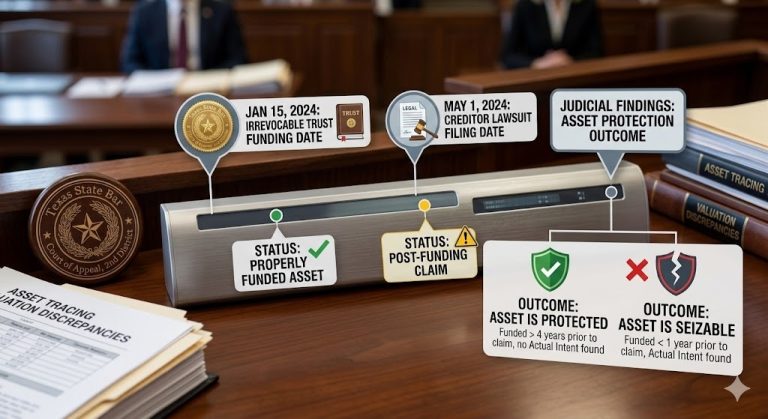
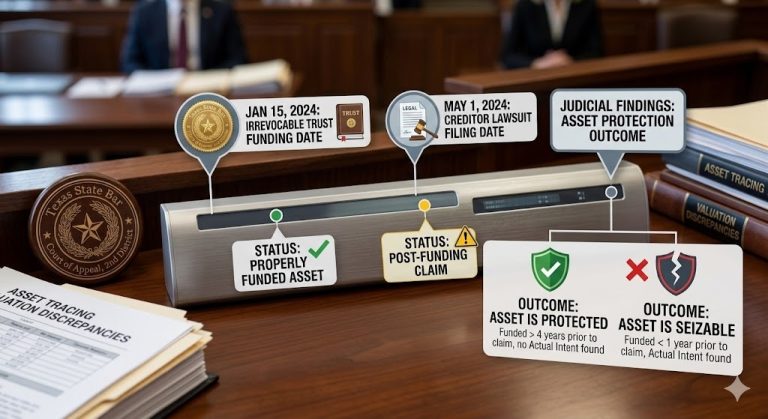
Fraudulent transfer challenges are not indefinite. The UVTA imposes a statute of limitations: creditors must bring a fraudulent transfer action within 4 years of the transfer date, or 1 year from the date they discovered (or should have discovered) the transfer — whichever is later.
This means that a transfer made in 2026 can be challenged until 2030, even if the creditor does not discover it immediately. If the creditor discovers the transfer later, they have 1 year from discovery, regardless of when the transfer occurred.
In bankruptcy, the limitations period is different. The bankruptcy trustee can use Section 548 to reach back 2 years for fraudulent transfers, or can use state UVTA law (through Section 544) for the longer state window. Self-settled asset protection trusts face a special 10-year bankruptcy lookback under BAPCPA Section 548(e) — one of the critical reasons the UltraTrust® non-self-settled structure provides substantially stronger protection.
For the practically minded: a transfer made well outside the UVTA window — 5+ years ago, when no claim was foreseeable — is almost entirely safe from fraudulent transfer challenge. This is the time horizon that proactive asset protection planning targets.
The UltraTrust Advantage
Estate Street Partners and the UltraTrust® program have guided clients through both proactive and reactive asset protection situations for 40+ years. Our multi-faceted team represent the multi-disciplinary expertise needed to identify what remains legitimately available after a threat emerges, and to design a forward-looking plan that prevents the same situation from occurring again.
For clients who are already inside a threat window, UltraTrust® provides a comprehensive assessment: what legitimate steps are available now, what exemptions apply in your state, what insurance options have not been maximized, and what a realistic timeline looks like for future protection as the statute of limitations clock runs. For clients who have not yet faced a threat, the message is simpler: the time to build your fortress is before the siege, not during it. Schedule a free consultation at ultratrust.com.
Common Mistakes to Avoid
Mistake 1: Panicking and making impulsive transfers. The most costly mistake is acting immediately and recklessly after a threat surfaces. Impulsive transfers that clearly violate the badges of fraud analysis make your legal position dramatically worse — you not only lose the asset protection but create evidence of bad faith that affects every other aspect of your defense.
Mistake 2: Relying on informal family arrangements. “I’ll put the house in my son’s name” — courts unwind these arrangements routinely and the transfer creates additional legal complications.
Mistake 3: Not consulting a qualified asset protection attorney. The line between legitimate restructuring and fraudulent transfer is technical and fact-specific. Acting without counsel in this situation is extremely high risk.
Mistake 4: Assuming offshore arrangements are untraceable. FBAR, FATCA, and FinCEN requirements have made offshore account concealment both detectable and criminal. The risks far exceed any potential benefit.
Mistake 5: Failing to document legitimate business purposes. Even transactions that are genuinely legitimate fail scrutiny when they are not documented at the time. Contemporaneous written records of business purpose, fair value analysis, and solvency at the time of transfer are essential.
Conclusion
The onset of a lawsuit threat is one of the most stressful moments a business owner, physician, or investor can face. It is also a moment that separates those who planned wisely from those who did not. For those who established their asset protection structure 5 or more years ago — with a properly structured irrevocable trust, sound entity architecture, and comprehensive insurance — a lawsuit is a manageable event. For those who did not plan and are now scrambling, the options narrow significantly.
What remains available is real but limited: maximize statutory exemptions, purchase exempt life insurance, document legitimate business restructuring, and engage counsel immediately. What must be avoided is the temptation to make impulsive transfers that create fraudulent transfer exposure and worsen an already difficult situation.
The most important lesson is one of timing: the time to build asset protection is when you do not need it. Schedule a free consultation today — before any threat emerges.
Frequently Asked Questions
[sp_easyaccordion id=”36213″]Helpful resources: Helpful next steps often include Asset Protection for Business Owners, LLC vs Trust for Asset Protection, and official SBA guidance when weighing practical next steps.
What often changes the answer
After reviewing Is It Too Late to Protect My Assets If I Know a Lawsuit Is Coming?, many people want a clearer sense of how the answer changes once real life timing, funding, and control are added to the discussion.
What usually shapes the next step
- Timing matters because asset protection works best before a claim becomes immediate.
- Control matters because keeping too much direct control can weaken the protection people hoped to create.
- Funding matters because creditors usually look at what was transferred, when it moved, and how the structure operates.
Where readers often continue
A practical next reading path is Asset Protection From Lawsuit, Asset Protection Trust, and Irrevocable Trust. When the question turns from reading to implementation, many readers move from these guides to a direct planning conversation.