
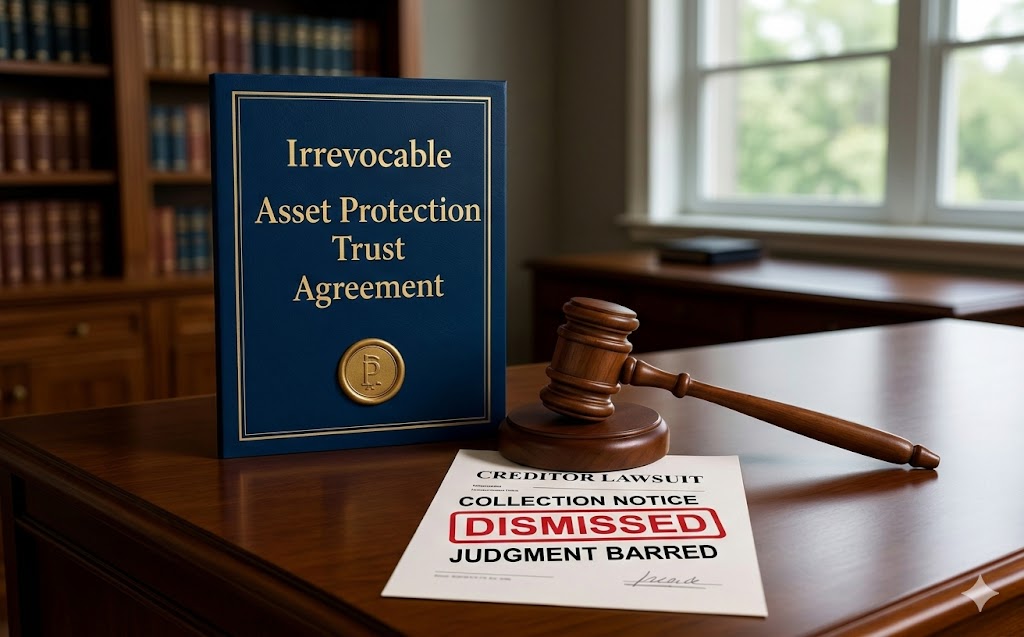
Generally, no — a creditor cannot seize assets held in a properly structured irrevocable trust. Once assets are legitimately and irrevocably transferred to an independent trust — with no retained control or beneficial interest by the original owner — those assets are no longer legally owned by the person being sued. Since creditors can only collect from assets that belong to the debtor, assets belonging to an irrevocable trust are outside their reach. However, this protection is not absolute. Several exceptions exist, and the structure of the trust determines whether it will withstand a creditor attack. Understanding what works, what fails, and why is essential for anyone using an irrevocable trust as an asset protection strategy.
Why Creditors Cannot Normally Reach Irrevocable Trust Assets
The legal foundation of irrevocable trust protection is the transfer of ownership. When you fund an irrevocable trust correctly, you are no longer the legal owner of those assets — the trust is. The trust is a separate legal entity with its own taxpayer identification number, its own bank accounts, and its own legal standing.
Creditors can only collect assets from the debtor. If the debtor does not own the asset, the creditor has no legal basis to seize it. This is not a loophole — it is the foundational legal principle that makes all forms of property rights work. When you give a gift to your child, your creditors cannot later demand the gift back. When you properly fund an irrevocable trust, the principle is the same.
The critical requirement is that the transfer must be genuine, complete, and not fraudulent. A nominal transfer — where you move assets to a trust but continue using them as if you still own them — will be seen through by a court. A genuine transfer — where ownership and control actually change — is legally defensible.
The Four Ways Creditors Try to Break Through Trust Protection
Creditors who know a debtor has assets in an irrevocable trust do not simply give up. They pursue several legal theories to try to reach those assets. Understanding these theories and how to defend against them is what separates a robust irrevocable trust structure from a weak one.
Theory 1: Fraudulent Conveyance The most common attack on an irrevocable trust is the claim that the transfer of assets was a fraudulent conveyance — a transfer made with intent to hinder, delay, or defraud creditors. If a creditor can prove that you transferred assets to the trust after you knew a lawsuit was likely, or while you were already insolvent, a court can void the transfer and restore the assets to your reach.
Fraudulent conveyance law applies to transfers made within a specific look-back period — typically two to four years under the Uniform Fraudulent Transfer Act, though some states allow longer periods. The IRS has up to six years in some cases. Transfers made well before any foreseeable legal threat are much safer.
Theory 2: Retained Control (Alter Ego) If you retain too much control over the trust — if you effectively dictate when and how assets are distributed, if you serve as trustee with unlimited power to benefit yourself, or if you continue using trust assets for personal purposes — a court may declare the trust your “alter ego.” An alter ego trust is treated as if it does not exist for creditor purposes.
The defense against this attack is genuinely giving up control. A truly independent trustee with genuine discretion to distribute — or not distribute — according to trust terms is the primary structural safeguard.
Theory 3: Self-Settled Trust in Non-DAPT States A “self-settled” trust is one where the grantor is also a beneficiary — meaning you can receive distributions from the trust. Most states do not recognize self-settled trusts as valid asset protection vehicles. If you created a self-settled irrevocable trust in a state that does not permit this, a court in your home state may treat the trust assets as still owned by you.
Only states with Domestic Asset Protection Trust (DAPT) statutes — including South Dakota, Nevada, Wyoming, Delaware, Alaska, and a handful of others — permit self-settled trusts and provide statutory creditor protection for them. If you live in a non-DAPT state and the lawsuit is heard in your home state court, the DAPT protection may not be respected.
Theory 4: Fraudulent Trust Administration Even if the trust was properly created, if the trustee administers it in ways that serve the grantor’s interests at the expense of the trust’s legitimate beneficiaries, a court may find the trust to be sham and ignore its protective structure. Trustees who always distribute to the grantor on request, who allow the grantor to direct investments, or who fail to maintain proper trust records are inviting a court to disregard the trust structure entirely.

What Makes an Irrevocable Trust Creditor-Proof
The irrevocable trusts that withstand creditor attacks share several structural characteristics that distinguish them from trusts that fail.
Genuine Irrevocability The trust must be truly irrevocable. The grantor cannot retain the power to amend, modify, or revoke the trust. Any retained amendment right — even a seemingly minor one — can be used by a creditor to argue that the grantor effectively retained ownership.
Independent Trustee The trustee must be someone other than the grantor, with genuine independence and genuine discretion. The trustee should make distribution decisions based on the beneficiaries’ needs and the trust’s stated standards — not based on what the grantor requests. Some asset protection attorneys recommend corporate trustees (licensed trust companies) for maximum independence.
Spendthrift Clause A spendthrift clause prohibits beneficiaries from voluntarily assigning their trust interests to creditors and prevents creditors from attaching those interests involuntarily. This is a standard provision in most asset protection trusts and is recognized in virtually every U.S. state.
Discretionary Distribution Standards A trust with fully discretionary distributions — meaning the trustee has complete discretion to distribute or not distribute — is more resistant to creditor attack than a trust with mandatory distribution requirements. If distributions are mandatory, a creditor can sometimes intercept them.
No Retained Beneficial Interest (Outside DAPT States) For maximum protection in most states, the grantor should retain no beneficial interest in the trust. If you are not a beneficiary, a creditor has no basis to attach your beneficial interest because no such interest exists.
Proper Funding Every asset intended to be protected must be properly titled in the name of the trust. Real property requires a deed transfer. Bank and investment accounts require new account titling. Vehicles require title changes. An unfunded trust is an empty legal shell that provides no protection.
The Charging Order: A Related but Different Concept
A charging order is a remedy available to creditors of LLC or limited partnership members. Instead of seizing the membership interest itself, a charging order entitles the creditor to receive any distributions that the LLC makes to the debtor-member — without giving the creditor voting rights or management control. This is different from irrevocable trust protection but often used in combination with it.
Many sophisticated asset protection plans pair an irrevocable trust (which owns) with LLCs or limited partnerships (which hold and manage specific assets). The irrevocable trust structure protects the ownership interest from the grantor’s creditors, while the charging order protection in the LLC adds another layer against attacks from the LLC level.
Real-World Creditor Attack Scenarios
Scenario 1: Medical Malpractice Judgment A surgeon with $3 million in personal assets establishes an irrevocable trust five years before a malpractice lawsuit is filed. The trust is properly funded, with an independent trustee and no retained beneficial interest. A jury awards $2.5 million against the surgeon. The plaintiff’s attorneys discover the irrevocable trust but cannot reach the assets — the transfer predates the lawsuit by five years, the surgeon retained no control, and no fraudulent conveyance can be established.
Scenario 2: Business Dispute A business owner transfers personal assets to an irrevocable trust and is later sued by a business partner for breach of contract. The lawsuit arises from post-transfer business activities. Because the trust was funded before the dispute arose and the grantor retained no interest, the trust assets are protected. The plaintiff can collect only against personal assets acquired after the trust was funded.
Scenario 3: Last-Minute Transfer (Failed) A real estate developer receives a demand letter from a contractor and immediately transfers assets to an irrevocable trust. Three months later, the contractor sues and wins. The court finds the transfer was a fraudulent conveyance — made with knowledge of the pending claim and within the statutory look-back period — and voids the transfer. The trust provided no protection because the timing was wrong.
State-by-State Variation in Creditor Protection
The strength of irrevocable trust protection varies significantly by state law. Several factors differ across jurisdictions:
Statute of Limitations for Fraudulent Conveyance Claims: Most states apply a two-to-four-year look-back period. Some states allow longer. The longer the look-back, the more vulnerable recent transfers are.
DAPT Recognition: States that have enacted DAPT statutes provide statutory protection for self-settled trusts. States without DAPT statutes do not — and courts in those states may refuse to recognize the DAPT protection created under another state’s laws.
Spendthrift Trust Recognition: All U.S. states recognize spendthrift trusts for third-party beneficiaries. Self-settled spendthrift trusts — where the grantor is also a beneficiary — are only valid in DAPT states.
Exception Creditors: Most states carve out exceptions to spendthrift protection for certain types of creditors: child support and alimony creditors, for example, can often reach spendthrift trust distributions regardless of the trust’s protective provisions.
Frequently Asked Questions
Can a divorce attorney seize assets in my irrevocable trust? It depends on state law and when the trust was funded. In many states, assets transferred to an irrevocable trust before marriage are protected in divorce. Assets transferred during marriage may be considered marital property depending on the circumstances.
What if I need money from the trust after a creditor sues me? You can request a distribution from the trustee, but the trustee has discretion to decline if doing so would expose the trust to a fraudulent transfer challenge. This is a real limitation — the protection comes at the cost of easy access.
Can a creditor sue the trustee of my irrevocable trust? In some circumstances, yes — particularly if the trustee made distributions to you after the creditor’s claim arose. Trustee conduct during and after a creditor claim is a critical compliance issue.
Does an irrevocable trust protect against all types of creditors? No. Exception creditors — particularly those with claims for child support, alimony, and in some states tort claims — may have special access to trust assets. Federal creditors including the IRS have broader collection powers than state court judgment creditors.
The Bottom Line
A properly structured irrevocable trust — genuinely irrevocable, independently administered, with full and proper funding occurring before any foreseeable legal threat — is one of the most powerful asset protection tools available under U.S. law. Courts have consistently upheld these structures against creditor attack when they meet the structural requirements. The key variables are timing, structure, and administration. Trusts that fail are those created too late, retained too much grantor control, or were administered in ways that blurred the line between the grantor and the trust. Get those elements right, and a creditor cannot seize your trust assets.
Helpful resources: For added perspective, readers often compare Asset Protection for Business Owners, LLC vs Trust for Asset Protection, and official SBA guidance while sorting through timing, control, and long-term protection choices.
Questions that usually come up next
People exploring Can a Creditor Seize Assets in an Irrevocable Trust? often move next to the practical questions: when to act, what to fund, and how much control can stay with the original owner.
Details that often change the outcome
- Timing matters because asset protection works best before a claim becomes immediate.
- Control matters because keeping too much direct control can weaken the protection people hoped to create.
- Funding matters because creditors usually look at what was transferred, when it moved, and how the structure operates.
What usually helps after the main answer
Many readers narrow the decision by comparing Asset Protection From Lawsuit, Asset Protection Trust, and Irrevocable Trust. When the question turns from reading to implementation, many readers move from these guides to a direct planning conversation.