
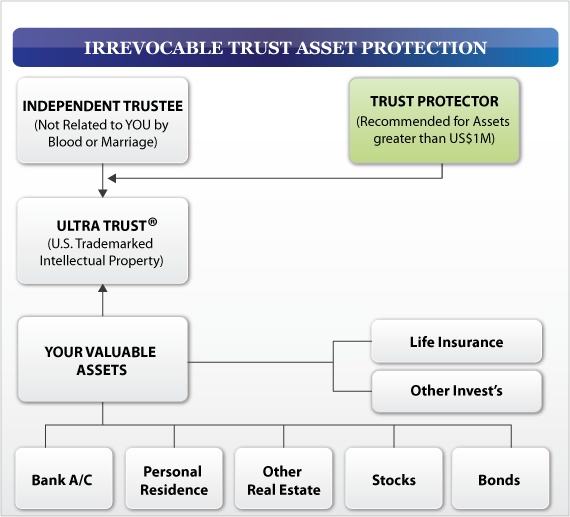
Asset protection trusts such as irrevocable trusts require an independent trustee
Asset Protection Strategies
There are many strategies to take the necessary steps in order to protect your hard earned assets. Unfortunately, there is not a simple solution for every situation. Each person will choose a different method. It is important that the method chosen will be the most beneficial in protecting all of your assets.
Asset Protection Trusts
Asset protection trusts are great tools to protect assets. There are many states that allow these trusts. Before, it was required for wealthy people to have offshore trusts. While this did protect their assets, it became very expensive and time consuming due to additional reporting requirements. Some states that now support asset protection trusts include Rhode Island, Alaska, Delaware and Nevada. The great thing about these trusts is that you do not need to be a resident of the state to buy into one. These trusts work to protect your assets by placing a portion of your assets in the hands of a trustee. The assets that are placed in the irrevocable trust will not be able to be touched by creditors.
Protect Assets from Your Children
In addition, the trusts can allow you to shield assets from your children. In order to set up this type of trust, there are some requirements that must be met. The trust must be irrevocable, it must have an independent trustee, distributions can only be made at the discretion of the trustee, the trust must have a spendthrift clause, some of the assets must be located in the state in which the trust is in and the documents pertaining to the trust must be located in the same state as the trust.
Accounts-Receivable Financing to Protect Assets
If you are a business owner, you may benefit from accounts-receivable financing. This is when you are allowed to borrow money against the receivables of the business and then place the money into a separate account that is non-business. This tool deters creditors and protects assets that would typically be attacked.
Remove Equity for Asset Protection
Another way to protect your assets is to remove all equity from them. When this is done, you can place the money into assets that are protected by your state. For example, if you are the owner of an apartment complex, you could take a loan against the equity of the building and place the money into an annuity, Roth IRA on Roids, or another protected asset.
Family Limited Partnership in Asset Protection
Family limited partnerships are also good asset protection tools. This is when assets are transferred into the partnership. The assets are then exchanged for shares in that partnership. Since the family limited partnership owns the assets, they are completely protected from creditors under the Uniform Limited Partnership Act. The general partner is still at risk, making the irrevocable trust a little stronger, however.
Simpler Ways to Protect Assets
Many of the mentioned strategies may be complex and confusing. There is no need to panic. There are easier ways to protect your assets from creditors. These strategies are inexpensive and effective. One of the most common strategies used by married couples is to transfer all assets into the spouse’s name. This will protect your assets, but if there is a divorce, the end result could cost you those assets. Make use of any employer-sponsored retirement plan. Most times, these plans are protected and offer a great way to save and protect your assets. Always take advantage of state laws regarding asset protection. The laws pertaining to homesteads, life insurance and annuities can be great tools when planning to protect your assets. For example, if you pay down your mortgage, you may be protecting the cash that would otherwise be vulnerable. Be sure to contact your state to find out what protection is offered before making any decisions. One thing to remember when planning to protect your assets is to never combine business assets with your personal assets. If the business fails, your personal assets could be in jeopardy if the assets have been combined.
Protect Your Assets Before There is a Problem
No matter what method you think will be best, always consult with a professional such as Estate Street Partners. Make sure you do some research and get references before hiring a consultant. If you have found an expert to help you plan, take the time needed to discuss every option. You want to make sure you are taking the right steps to protect all of your assets in the event of a lawsuit. Finally, don’t wait. Protect those assets before there is a problem.
Read more on Asset Protection Strategy: Part 1 of 3
Read more on Asset Protection Trust & Estate Planning
Helpful resources: Readers often continue with Asset Protection Trust, Revocable vs Irrevocable Trust, and official IRS estate and gift tax guidance when weighing practical next steps.
Questions that usually come up next
People exploring Asset Protection Strategies often move next to the practical questions: when to act, what to fund, and how much control can stay with the original owner.
Details that often change the outcome
- Timing matters because planning choices usually become narrower once a problem is already close.
- Control matters because the answer often depends on how much access or authority the owner wants to keep.
- Funding matters because a trust or entity has to be set up and maintained correctly to matter.
What usually helps after the main answer
Many readers narrow the decision by comparing Asset Protection Trust, Irrevocable Trust, and How It Works. When the question turns from reading to implementation, many readers move from these guides to a direct planning conversation.