
As lawsuits and creditors are increasing every day, reducing wealth from lawsuits or creditors is very important in today’s society. Asset protection strategies exist to protect your assets from these risks (while having access to and control over them). There are many techniques that can separate your personal property from your business property and there are advanced planning techniques. If you are a businessman, a high-net-worth individual, or someone looking for future security, you must understand asset protection and implement it. In this article, we share some important asset protection strategies, why they are important, and how you can apply them.
What Are Asset Protection Strategies?
Asset Protection Strategies refer to legal and financial techniques used to safeguard your wealth from potential threats. These techniques can be used by individuals and businesses alike. The purpose of asset protection is not to avoid legal obligations but to protect assets in a legal and proactive manner.
Importance of Asset Protection
If they do not protect their assets, individuals and business owners can lose a lot of money in lawsuits, divorce, bankruptcy, etc. Through planning it is possible to easily mitigate these risks which encourages individuals to secure their assets with no sudden loss of money.
Common Asset Protection Methods
| Method | Description | Effectiveness |
| Irrevocable Trusts | Transfers assets to a trust that cannot be changed. | High |
| Limited Liability Companies (LLCs) | Separates business assets from personal wealth. | Moderate to High |
| Homestead Exemption | Protects a primary residence from creditors. | Moderate |
| Offshore Trusts | Holds assets in foreign jurisdictions with stronger protections. | Very High |
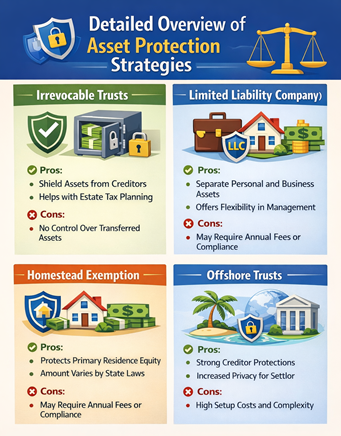
Detailed Overview of Asset Protection Strategies
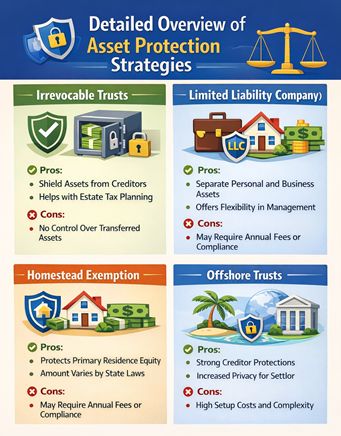
Asset protection can be effectively achieved with the right strategy selection. Asset protection strategies – their pros and cons. We discuss some of the best available below.
Irrevocable Trusts
In the case of an irrevocable trust, the party creates this trust, the settlor, does not have the power to change or revoke it. When you put your assets into an irrevocable trust, you lose all control over them those assets are owned by the trust. This can afford you a strong level of protection during litigation as creditors generally can’t touch these assets. After that date, the person who set up the trust, known as the trustor, cannot change or take away any of the assets in the trust.
Benefits of Irrevocable Trusts:
- You do not have control of the assets so they are protected from creditors.
- Estate planning offers assistance with estate tax planning and the transfer of wealth to heirs.
- When you transfer your assets to a trust, you lose control of those assets.
Limited Liability Companies (LLCs)
Getting an LLC Business Owner Asset protection is the most common reason business people form an LLC. A limited liability company (LLC) separates your personal assets and your business assets. As a result, your individual assets are safe from attack in the event a client takes action against your business. Startups and investors particularly find this strategy helpful.
Benefits of LLCs:
- Separation of Assets: Protects personal assets from business-related risks.
- Creditor Protection: Personal creditors cannot access LLC assets.
- Flexibility: LLCs offer flexibility in terms of ownership and management.
Homestead Exemption
Homestead exemption refers to a state-specific asset protection strategy that permits homeowners to shield some of the value of their primary residence from creditors. In a few states, this shield is offered no matter how large or small the equity. You may not be able to protect your assets, but this financial bankruptcy protection may come in handy for individuals.
Benefits of Homestead Exemption:
- Protection of Primary Residence: Helps protect home equity from creditors.
- State-Specific: The amount of protection depends on your state’s laws.
- Limited Scope: Does not protect against all types of creditors or debts.
Offshore Trusts
Offshore trusts refer to the holding of assets in foreign jurisdictions which ensure maximum asset protection. There are stronger creditor protection laws in these jurisdictions. Offshore trusts represent a more sophisticated method of asset protection often employed by wealthy investors to shelter a large amount of wealth.
Benefits of Offshore Trusts:
- Enhanced Legal Safeguards: Offshore locations feature strong creditor protection statutes.
- Offshore trusts are private trusts, which means there will be more privacy than what will be offered by the U.S. However, setting up an offshore trust can be costly and complex.
Comparing Asset Protection Strategies
Asset protections strategies offer a wide range of levels of protection. In this part, we are going to contrast these tactics regarding efficiency and suitability for various kinds of assets and situations.
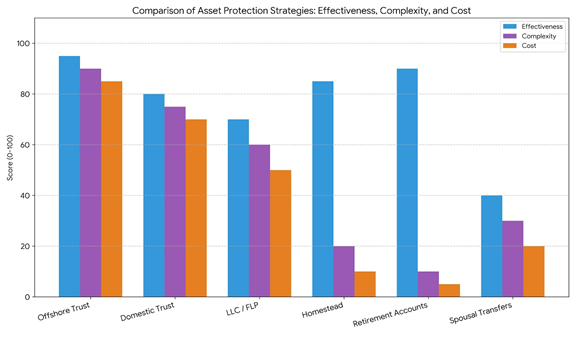
- The highest-level offshore trusts provide the strongest protection available (95%) but come with the most complexity and cost. As such, they are only practical for high-net-worth individuals or those with very specific needs.
- Legal protections that shield your assets are the easiest place for you to begin asset protection. They are 85-90% highly effective and, due to law protection, they involve practically no difficulties or ongoing costs.
- Middle-Ground Solutions: LLCs and Family Limited Partnerships (FLPs) are effective tools with reasonable protection and complexity at a fair price and are usually used for business or real estate holdings.
Irrevocable Trust vs. LLCs
While irrevocable trusts are excellent for personal asset protection, LLCs are more flexible and beneficial for business owners. LLCs do not protect personal assets as much as other entities but offer business protection.
Homestead Exemption vs. Offshore Trusts
Homestead exemptions are less protective – they usually cap the amount of equity you can protect in your primary residence, while offshore trusts protect many assets much better. However, it is more complicated and costly to set up offshore trust.
How to Choose the Right Asset Protection Strategy
In selecting the best asset protection strategy, a number of conditions will come into play. These include your situation, the assets you wish to protect and the long term outlook. Here is a step by step guide to select any strategy.
- Evaluate what you want to protect: these could be anything from personal assets to business and real estate. Different types of assets require different strategies to succeed.
- When high net worth assets or risks of excessive liability are shielded, stronger asset protection may be needed. These may include an irrevocable trust or offshore trust.
- Get professional help so that your asset protection is legally valid. Work with an estate planning attorney or similar professional to have a result that suits your unique situation.
- Cost and complexity of strategies such as offshore trusts vary, with some being more expensive and complex than others. Make sure you’re comfortable with costs and admin efforts.
- It is advisable to prepare in advance because asset protection. Make a plan before you experience a financial hardship, and review that plan regularly.
Conclusion
Ultra Trust Strategies to protect your assets is necessary if you want to save your wealth. If you choose an irrevocable trust, LLC, homestead exemption, offshore trust, you will have to think carefully about your objectives and the amount of protection you need. By planning ahead of time by talking to someone, you have a shot at creating an asset protection strategy that will secure your assets.
FAQ Section
Q.1. What is the best asset protection strategy?
The most effective method to safeguard your assets will depend on personal circumstances. Irrevocable trusts provide good protection of personal assets as they make it hard for creditors to reach those assets. As a business owner, forming an LLC is a great option as it helps in separating your business assets from your personal wealth. This way, it offers more security.
Q.2. How do offshore trusts protect my assets?
Offshore trusts are more protective than regular trusts because they place your assets outside the reach of creditors.
Q.3. Can I change the terms of an irrevocable trust?
No, you can’t change the terms or take back the assets once they are in an irrevocable trust after their creation without the beneficiaries’ consent.
Q.4. Does the homestead exemption protect all my assets?
The answer is no – the homestead exemption only protects a portion of the equity in your primary residence and doesn’t apply to all types of debt.
Q.5. How much does it cost to set up an offshore trust?
Offshore trusts have expensive set-up and maintenance charges on account of legal and administrative fees. Usually, high-net-worth individuals use them.